
Cryogenics and the Demand for Quality Valves: What You Need to Know
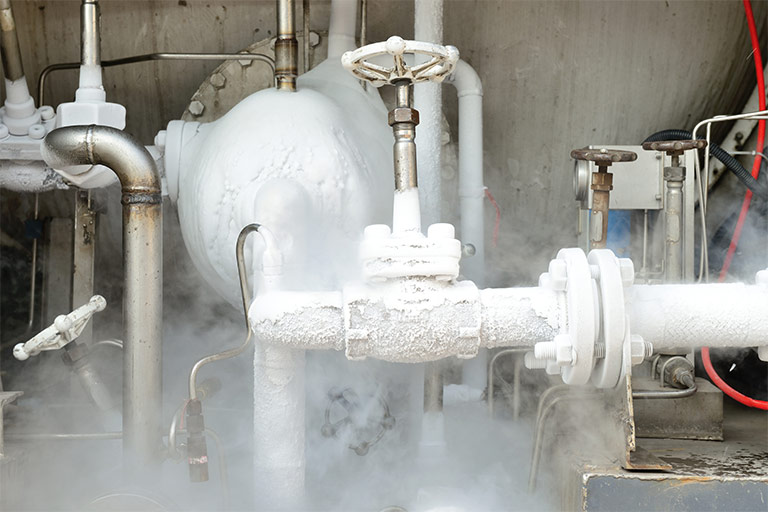
Why Standard Valves Fail in Cryogenic Service
Most valves are not built for cryogenic service — and using the wrong one carries real consequences. At temperatures below -100°C (-148°F), the industry threshold for cryogenic service, the physics of how materials behave change fundamentally. Metals contract. Elastomers that perform reliably at ambient temperatures become brittle and lose their sealing properties. Components that cycle repeatedly through extreme temperature swings accumulate stress that standard valve designs are simply not engineered to absorb.
The defining challenge of cryogenic valve selection is this: nearly every failure mode that destroys a valve in cryogenic service is invisible at room temperature. A valve that passes inspection, seats cleanly, and shows no leakage in ambient conditions can fail catastrophically once it sees liquid nitrogen, liquid oxygen, or LNG. Material selection, dimensional tolerances, and seal geometry all have to be specified with the cold end of the operating range as the governing condition, not as an afterthought.
The consequences of getting it wrong include leaks, pressure drops, and safety hazards that can compromise entire filling or handling operations. In services involving liquid oxygen or hydrogen, the stakes are higher still.
What Makes Cryogenic Applications Unique and Demanding
Cryogenics is the science of producing and managing extremely low temperatures, generally defined as -150°C (-238°F) and below. At these temperatures, gases like nitrogen, oxygen, argon, and natural gas condense into liquid form, making them far easier to store and transport in large volumes. That’s the essential value proposition: liquefy industrial gases to enable efficient handling across the supply chain.
But operating at these extremes introduces serious engineering challenges that go beyond what standard industrial valve specifications address. While the formal scientific definition of cryogenic temperatures begins at -150°C (-238°F), the practical industry threshold for requiring specifically engineered components is -100°C (-148°F). Below that point, material behavior, seal performance, and dimensional tolerances all diverge sharply from what standard compressed gas or process valve specifications address.
Common Failure Modes in Cryogenic Valve Service
Understanding what causes cryogenic valves to fail is the first step to specifying components that won’t.
Cold flow degradation is one of the most common and insidious failure modes. Certain polymers and soft-seat materials, including many that perform well in ambient or moderate-temperature service, deform permanently under sustained load at cryogenic temperatures. This phenomenon, known as cold flow or creep, causes seat materials to lose their geometry over time, degrading shutoff performance and eventually resulting in leakage that cannot be corrected without replacing the component.
Seal embrittlement from thermal cycling is another leading cause of field failures. Each time a valve transitions between ambient and cryogenic temperatures, its components expand and contract different amounts depending on their material. Elastomeric seals that lack sufficient low-temperature flexibility will crack under this cycling, and metal components that are not matched for compatible thermal expansion coefficients can develop leak paths at joints and sealing surfaces. Valves not specifically designed for cryogenic service are particularly vulnerable here, as their seal geometry and material selections are optimized for a much narrower temperature range.
Ice formation from moisture ingress can mechanically jam valve mechanisms and crack components. When ambient-temperature moisture contacts a surface that has been chilled to cryogenic temperatures, it freezes immediately. In a valve, this can bind moving parts, prevent proper seating, and in severe cases, generate enough force during freeze-thaw cycling to crack valve bodies or fracture brittle components. Proper purging procedures and valve designs that minimize moisture traps are essential mitigation strategies in cryogenic applications.
What Quality Looks Like in a Cryogenic Valve
Not all valves are built for cryogenic service. Selecting the right valve means evaluating several critical factors:
- Material compatibility. The body, stem seals, seats, and internal components must be rated for cryogenic temperatures and compatible with the specific gas being handled — whether that’s liquid oxygen, nitrogen, hydrogen, or LNG. Chemical compatibility is especially critical; certain elastomers and polymers that perform well in standard service become brittle or react adversely at ultra-low temperatures.
- Thermal expansion management. As heat is absorbed from the environment, valve components expand and contract. Quality cryogenic valves are designed with appropriate insulation and dimensional tolerances that account for this movement without compromising seal integrity.
- Flow performance. High flow capacity with minimal pressure drop is essential in cryogenic applications. A valve’s flow coefficient (Cv) is a key specification. A higher Cv means greater flow with less pressure drop across the valve, enabling reduced energy consumption across the system
Introducing the CryoFlo® CFC-50: Built for Cold Flow Demands
CPV Manufacturing’s CryoFlo CFC-50 check valve was designed specifically for bulk tank installations and gas filling operations, or environments where reliability under cold flow conditions is non-negotiable.
The body and retainer are fabricated from naval brass, which maintains ductility and dimensional stability through repeated thermal cycling — resisting the stress cracking that can affect some stainless alloys in cryogenic service. The guide uses Kel-F® (PCTFE), a fluoropolymer chosen for its resistance to cold flow creep, low thermal expansion coefficient, and broad chemical compatibility, including liquid oxygen service. Together, these material choices directly address the two most common cryogenic valve failure modes: seal deformation under load and embrittlement through temperature cycling.
With a flow coefficient of 3.53 Cv, the CFC-50 delivers high flow rates with low pressure drop. This reduces energy cost and maintains system throughput in demanding fill operations. The spring-assisted disc design seats reliably when forward flow stops, without rattling or vibration. The standard model is rated to 7,000 PSIG (483 BAR); custom configurations are available up to 10,000 PSIG (689 BAR).
The valve is designed for pipelines up to two inches and is in stock — a meaningful advantage in a market where parts availability has become an increasing concern as demand outpaces supply.
Why This Matters Now
The global cryogenic equipment market is growing rapidly, and the engineering challenges described above are playing out at scale. According to recent market research from MarketsandMarkets, the industry is projected to grow from approximately $13.55 billion in 2024 to $22.96 billion by 2030, representing a CAGR of 9.3%. That growth is being driven by surging demand for LNG as a transitional energy source, expanding hydrogen infrastructure, and increasing industrial gas consumption across healthcare, electronics, and aerospace.
LNG continues to expand its role as a transitional energy source with significantly lower carbon emissions than coal or oil, prompting heavy infrastructure investment in liquefaction, storage, and regasification terminals — particularly across Asia Pacific, the Middle East, and North America. Meanwhile, growing interest in hydrogen as a clean energy carrier is opening a new frontier for cryogenic storage and transport technology.
In industrial gas filling operations, increasing global project activity is putting pressure on component supply chains. Operators who rely on cryogenic infrastructure cannot afford unplanned downtime — which is precisely why parts availability, material quality, and proven performance matter more than ever.
CPV Manufacturing has served industrial gas applications for decades, with a track record of delivering valves and fittings built to perform in the most demanding environments. Whether you’re specifying components for a new system or sourcing reliable replacements for existing infrastructure, we’re here to help. Explore our full line of valves and fittings or contact our team to discuss your application requirements.
Frequently Asked Questions
What temperature is considered cryogenic service?
The industry threshold for cryogenic service is continuous operating temperatures below -100°C (-148°F), which is the point at which components require specific material and design engineering. The formal scientific definition is -150°C (-238°F), roughly where most common industrial gases condense into liquid form. Applications involving liquid nitrogen (-196°C), liquid oxygen (-183°C), liquid hydrogen (-253°C), or LNG (-162°C) all fall clearly within cryogenic service requirements.
What causes cryogenic valve failure?
Most cryogenic valve failures trace back to one of three root causes. Cold flow: polymer seat and guide materials that lack creep resistance deform under sustained load, causing progressive leakage that worsens over time. Seal embrittlement: elastomeric seals not rated for low-temperature service crack through repeated thermal cycling, creating leak paths that require valve replacement. Incompatible thermal expansion: mismatched expansion coefficients between components build mechanical stress through temperature cycling, eventually causing fatigue failures at joints and sealing surfaces.
What is the difference between a cryogenic valve and a standard valve?
A cryogenic valve is engineered specifically to operate reliably below -100°C; a standard valve is designed for ambient or moderate-temperature service. Cryogenic valves use body materials selected for ductility and dimensional stability at extreme low temperatures. Their seat and seal materials are chosen for low cold-flow characteristics and chemical compatibility with cryogenic fluids. Dimensional tolerances account for contraction at operating temperature, so the valve maintains proper sealing function in the cold condition — not just at room temperature. Standard valves lack these design features and typically fail quickly in sustained cryogenic service.
What materials are used in cryogenic valves?
For valve bodies, naval brass and austenitic stainless steels (304 and 316 series) are commonly used because they retain ductility at low temperatures. For seats and guides, PCTFE (Kel-F®) is a preferred choice due to its very low cold-flow tendency, low thermal expansion coefficient, and broad chemical compatibility — including liquid oxygen service. PTFE is also used in some cryogenic applications, though it exhibits more cold flow than PCTFE under load. Standard elastomers such as Buna-N or neoprene are generally unsuitable for cryogenic service.
About the Author:
Joshua Raizman
Government Sales Manager